
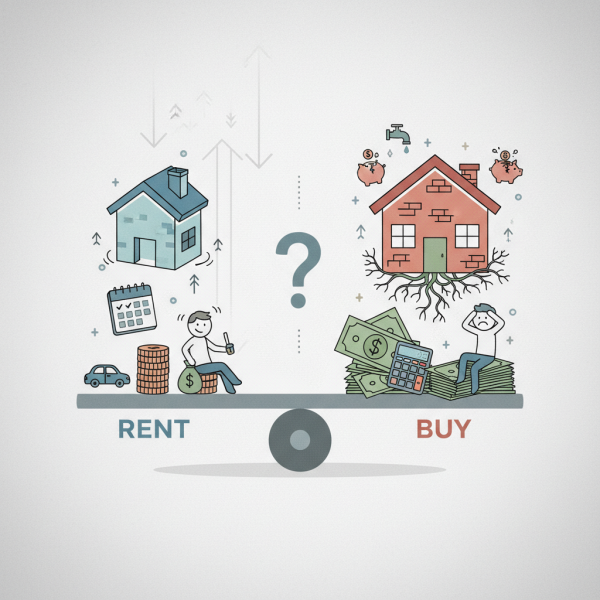
Renting vs. Buying: A Financial Guide
What you'll learn
 The Perennial Housing DilemmaUnderstanding the True Costs of RentingDeconstructing the Comprehensive Costs of BuyingMaking Your Personalized Decision
The Perennial Housing Dilemma
Deciding whether to rent or buy a home is one of the most significant financial choices many individuals will face. It's a question fraught with emotion, societal expectations, and often, oversimplified advice. While the dream of homeownership is deeply ingrained, it's crucial to approach this decision with a clear head, backed by solid financial analysis. This article aims to cut through the noise, providing a math-based framework to help you determine which housing option genuinely aligns with your current financial situation and life stage, empowering you to make a savvy, informed choice rather than an emotional one.
The Common Wisdom vs. Financial Reality
For generations, owning a home has been touted as the ultimate financial goal – an investment that always pays off and a symbol of stability. While homeownership can indeed be a powerful wealth-building tool, it's not a universal truth nor is it always the best immediate option for everyone. The 'rent money is dead money' adage often overlooks the significant, non-recoupable costs associated with buying, alongside the flexibility and lower financial commitment that renting offers. True financial savviness means evaluating both options objectively, calculating their real costs and benefits.
Understanding the True Costs of Renting
Renting is often perceived as simpler financially, and in many ways, it is. Your primary expense is typically a fixed monthly rent payment. However, to conduct a fair comparison, it's essential to account for all associated costs:
- Monthly Rent: This is the most obvious and usually the largest expense.
- Utilities: Electricity, gas, water, internet, and sometimes trash collection are typically separate from rent.
- Renter's Insurance: A relatively inexpensive but vital protection for your belongings against theft, fire, or damage.
- Security Deposit: An upfront cost, often equivalent to one or two months' rent, which is typically refundable upon move-out assuming no damages.
- Pet Fees: If you have pets, these can add to upfront and ongoing costs.
- Flexibility and Mobility: While not a direct cost, the ease of relocating without the burden of selling property has significant value, especially for those whose careers or life circumstances may change frequently.
When you rent, your budget is generally more predictable, and you aren't responsible for major maintenance or repair costs, which fall to the landlord.
Deconstructing the Comprehensive Costs of Buying
The costs of homeownership extend far beyond the monthly mortgage payment. Many hidden or overlooked expenses can significantly impact your overall financial picture. Understanding these is paramount.
Upfront Costs: The Initial Hurdles
- Down Payment: Typically 3.5% to 20% or more of the home's purchase price. This is a substantial sum that ties up liquid assets.
- Closing Costs: These are fees paid at the close of a real estate transaction, typically ranging from 2% to 5% of the loan amount. They include loan origination fees, appraisal fees, title insurance, legal fees, recording fees, and sometimes points to lower your interest rate.
- Moving Expenses: The cost of movers, packing supplies, and transferring utilities.
- Home Inspection: A necessary expense to identify potential issues before purchase.
- Initial Repairs/Renovations: Even a move-in ready home might require immediate personal touches or minor fixes.
Ongoing Costs: The Monthly and Annual Ledger
- Mortgage Principal & Interest (P&I): This is the core of your monthly payment, paying down the loan balance and the cost of borrowing.
- Property Taxes: Assessed by local governments, these can be substantial and fluctuate over time. They are often escrowed and paid with your mortgage.
- Homeowner's Insurance (HOI): Protects your home and assets against damage, theft, and liability. Also often escrowed.
- Private Mortgage Insurance (PMI): If your down payment is less than 20%, lenders typically require PMI, adding to your monthly costs until you build sufficient equity.
- Homeowners Association (HOA) Fees: Common in condos, townhouses, and some planned communities, these cover shared amenities and maintenance.
- Utilities: Similar to renting, but potentially higher for larger homes.
- Maintenance and Repairs: This is a major differentiator. Homeowners are responsible for everything from leaky faucets to roof replacements, averaging 1-4% of the home's value annually. Budgeting for emergencies is critical.
- Landscaping/Pest Control: Additional costs for property upkeep.
The Math: Comparing the Total Monthly Outlay
To truly compare renting and buying, you must look beyond just the rental payment versus the mortgage payment. You need to calculate the total monthly housing cost for each scenario. For buying, this means P&I + Taxes + Insurance + PMI (if applicable) + HOA (if applicable) + estimated monthly maintenance. Only then can you make an accurate apples-to-apples comparison.
For example, a $2,000 rent payment might seem higher than a $1,500 mortgage payment. But if that mortgage comes with $400 in property taxes, $150 in insurance, $70 in PMI, and an estimated $200 for monthly maintenance, your actual ownership cost jumps to $2,320 – suddenly making the rental option look more attractive from a pure cash flow perspective, especially when considering the opportunity cost of the down payment.
The Long-Term Perspective: Equity and Appreciation
One of the primary financial benefits of buying is building equity. Each mortgage payment contributes to reducing your principal, and over time, your ownership stake grows. Additionally, real estate often appreciates in value, further increasing your equity. However, appreciation is not guaranteed and can fluctuate with market conditions. A common rule of thumb suggests that you generally need to stay in a home for at least five years for the costs of buying and selling to be offset by equity growth and appreciation.
The Opportunity Cost of Your Down Payment
A significant factor often overlooked is the opportunity cost of the large sum tied up in a down payment and closing costs. This capital could otherwise be invested in the stock market, retirement accounts, or other ventures that could generate substantial returns. For instance, if you have $50,000 for a down payment, but could rent a comparable property for less than the total cost of ownership, that $50,000 invested elsewhere (e.g., in a diversified portfolio averaging 7% annual returns) could grow significantly over several years. Calculating this potential return helps paint a more complete financial picture.
Flexibility, Lifestyle, and Life Stage
Beyond the numbers, lifestyle factors play a significant role. Renting offers unparalleled flexibility. You can move for a new job, a change of scenery, or to downsize without the complex process and costs of selling a home. This can be invaluable for younger professionals, those in transitional life stages, or anyone prioritizing mobility.
Buying, conversely, offers stability, a sense of permanence, and the freedom to customize your living space. It can foster community roots and provide a tangible asset for your family. Understanding your current life stage – whether you're building a career, starting a family, or nearing retirement – is crucial for aligning your housing choice with your broader life goals.
Making Your Personalized Decision: A Step-by-Step Approach
To make the smartest financial housing decision for you, follow these steps:
- Assess Your Financial Health: Honestly evaluate your income stability, savings for a down payment and emergency fund, and existing debt levels. Can you comfortably afford the upfront and ongoing costs of buying without being house-poor?
- Calculate ALL Costs: Get real estate agent and lender estimates for potential buying costs (down payment, closing costs, mortgage P&I, taxes, insurance, PMI, HOA, maintenance). Compare this total monthly outlay to the all-inclusive costs of renting a comparable property in your desired area.
- Consider Your Time Horizon: If you anticipate moving within 5 years, renting is almost always the more financially sound option due to transaction costs. The longer you plan to stay, the more favorable buying becomes.
- Evaluate Opportunity Costs: Compare the potential returns you could get from investing your down payment elsewhere versus the projected equity growth and appreciation of a home.
- Prioritize Lifestyle: How important is flexibility versus stability and customization? Your personal preferences should factor into the equation alongside the numbers.
Summary: No One-Size-Fits-All Answer
The decision to rent or buy is deeply personal and rarely simple. There isn't a universal 'right' answer, as it depends entirely on your individual financial situation, life stage, and personal priorities. By taking a rigorous, math-based approach, meticulously calculating all upfront and ongoing costs for both options, understanding the opportunity cost of capital, and honestly assessing your need for flexibility versus stability, you can make a financially savvy housing decision that truly serves your best interests. Remember, smart money management means making choices that align with your unique circumstances, not blindly following conventional wisdom.
Comprehension questions
 What are some of the often-overlooked, non-recoupable costs associated with buying a home that the 'rent money is dead money' adage typically ignores?Besides monthly rent, what are the primary associated costs a renter should consider when making a financial comparison to homeownership?According to the article, why is considering the 'opportunity cost' of a down payment crucial when deciding whether to rent or buy?What key factors should individuals assess in a step-by-step approach to make a personalized and financially savvy housing decision?