
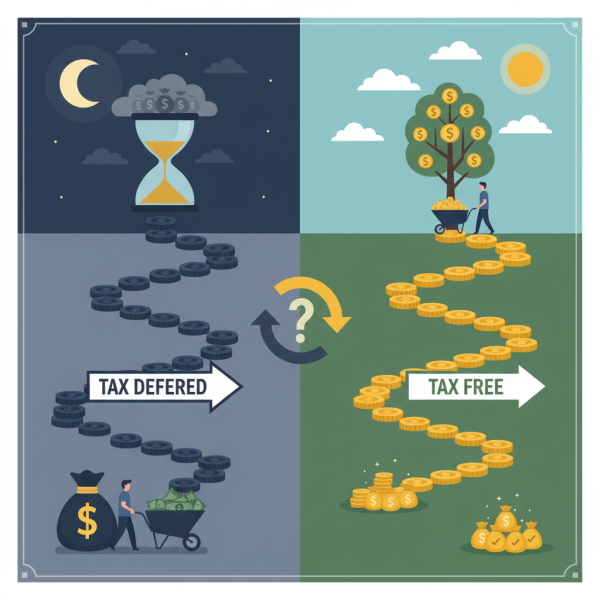
Roth vs. Traditional IRA Retirement Accounts and Tax Implications
What you'll learn
 Retirement PlanningTax StrategiesPersonal FinanceInvestment Choices
Embarking on the journey of retirement planning can feel like deciphering a complex puzzle, especially when it comes to understanding the various investment vehicles available. Among the most popular and impactful options for individual savers are the Roth IRA and the Traditional IRA. Both offer incredible tax advantages to help your money grow, but they operate on fundamentally different tax philosophies. The core decision boils down to a pivotal question: would you prefer to pay taxes on your retirement contributions now, or defer them until you withdraw your money in retirement? Understanding the nuances of each can significantly impact your financial future, helping you make a choice that aligns with your current financial situation and your long-term wealth accumulation goals.
The Foundation: What is an IRA?
Before diving into the specifics of Roth and Traditional accounts, let's briefly revisit what an Individual Retirement Account (IRA) is. An IRA is a tax-advantaged savings plan designed to help individuals save for retirement. The primary benefit of an IRA is that your investments can grow without being subject to annual taxes on dividends, interest, or capital gains within the account. This allows your money to compound more effectively over time, a powerful principle known as tax-deferred or tax-free growth. While there are limits to how much you can contribute each year, IRAs offer a flexible and accessible way for almost anyone to start building a retirement nest egg.
Traditional IRA: The "Pay Later" Strategy
The Traditional IRA embodies the 'pay later' philosophy. When you contribute to a Traditional IRA, your contributions may be tax-deductible in the year they are made. This means that you can potentially reduce your taxable income for the current year, leading to a lower tax bill today. The money you contribute then grows on a tax-deferred basis. You won't pay any taxes on the growth or the principal until you start taking withdrawals in retirement, typically after age 59½.
At that point, all withdrawals are generally taxed as ordinary income. This structure makes a Traditional IRA particularly attractive to individuals who expect to be in a higher tax bracket during their working years and anticipate being in a lower tax bracket in retirement. By deferring taxes, you save money now when your income is higher and pay later when your income might be lower. It's important to note that if you or your spouse are covered by a retirement plan at work (like a 401(k)), the deductibility of your Traditional IRA contributions might be limited based on your income.
Additionally, Traditional IRAs come with Required Minimum Distributions (RMDs) starting at a certain age, currently 73, meaning you must begin withdrawing a minimum amount from your account annually whether you need the money or not. This ensures that the government eventually collects its share of taxes on the deferred income.
Roth IRA: The "Pay Now" Advantage
Conversely, the Roth IRA operates on the 'pay now' principle. Contributions to a Roth IRA are made with after-tax dollars. This means you won't get an upfront tax deduction in the year you contribute. However, this initial tax payment comes with a significant reward: all qualified withdrawals in retirement are completely tax-free. Not only do your contributions come out tax-free, but all the investment earnings and growth are also tax-free, provided you've met certain conditions, such as having the account open for at least five years and being at least 59½ years old.
The Roth IRA is often favored by individuals who anticipate being in a higher tax bracket in retirement than they are today. If you believe tax rates will rise in the future, or if you are currently in a lower tax bracket, paying taxes on your contributions now could be a highly advantageous move. Another compelling benefit of a Roth IRA is that original owners are not subject to Required Minimum Distributions (RMDs) during their lifetime. This offers greater flexibility in how and when you take your money, and it can be a powerful tool for estate planning.
It's worth noting that Roth IRAs have income limitations for direct contributions, meaning high-income earners might not be eligible to contribute directly. However, for those exceeding the direct contribution limits, a 'backdoor Roth' conversion can offer an alternative pathway to fund a Roth IRA, demonstrating the account's enduring appeal for long-term tax-free growth.
Key Differences at a Glance
To help solidify your understanding, here's a quick comparison of the main distinctions between a Roth and a Traditional IRA:
- Contribution Tax Treatment: Traditional IRA contributions may be tax-deductible now, reducing current taxable income. Roth IRA contributions are made with after-tax dollars, offering no immediate tax deduction.
- Withdrawal Tax Treatment in Retirement: Traditional IRA withdrawals are taxed as ordinary income in retirement. Qualified Roth IRA withdrawals are completely tax-free in retirement.
- Income Limitations: Traditional IRAs have no income limits for contributing, but deductibility may be phased out for high earners covered by workplace plans. Roth IRAs have income limits for direct contributions.
- Required Minimum Distributions (RMDs): Traditional IRAs require RMDs starting at age 73. Roth IRAs do not have RMDs for the original owner.
- Flexibility: Roth contributions can be withdrawn tax and penalty-free at any time, providing a useful emergency fund option, though earnings are subject to rules. Traditional IRA withdrawals before 59½ often incur penalties.
Deciding Which Path is Right for You
Choosing between a Roth and a Traditional IRA isn't a one-size-fits-all decision. Your ideal choice hinges on several personal financial factors and your predictions about future tax landscapes. It’s essential to consider your current income, your projected income in retirement, and your long-term financial goals.
Consider a Traditional IRA if:
- You are currently in a high tax bracket and expect to be in a lower tax bracket during retirement. The upfront tax deduction is very valuable now.
- You want to reduce your current taxable income as much as possible.
- You don't mind paying taxes later, when you anticipate your income will be lower.
Consider a Roth IRA if:
- You are currently in a lower tax bracket and expect to be in a higher tax bracket during retirement. Paying taxes now at a lower rate is beneficial.
- You anticipate tax rates will increase in the future, making tax-free withdrawals in retirement more valuable.
- You want the flexibility of tax-free withdrawals in retirement and no RMDs for the original owner.
- You value the ability to withdraw your original contributions penalty-free at any time for emergencies.
Many individuals find that a diversified approach, contributing to both a Traditional IRA and a Roth IRA (or a Traditional 401(k) and a Roth 401(k) if available through work), offers the best flexibility. This strategy, sometimes called 'tax diversification,' allows you to hedge against uncertainty regarding future tax rates and gives you options for tax-free or tax-deferred income streams in retirement.
Summary
In summary, the choice between a Roth and a Traditional IRA is a fundamental decision in personal finance, centering on when you prefer to pay taxes on your retirement savings. The Traditional IRA offers potential upfront tax deductions and tax-deferred growth, with taxes paid on withdrawals in retirement. The Roth IRA requires after-tax contributions but rewards you with completely tax-free withdrawals in retirement, along with no RMDs for the original owner. Your current and future tax bracket, income limitations, and desire for flexibility are all crucial factors in determining which vehicle, or combination of both, best suits your unique financial journey. Making an informed decision now can set you on a path to a more secure and tax-efficient retirement.
Comprehension questions
 What is the primary tax difference between a Traditional IRA and a Roth IRA regarding contributions and withdrawals?Under what circumstances might an individual prefer to contribute to a Traditional IRA over a Roth IRA?What are two key advantages of a Roth IRA, particularly regarding withdrawals and Required Minimum Distributions?Why might tax diversification, involving both Roth and Traditional accounts, be a beneficial strategy for retirement planning?