
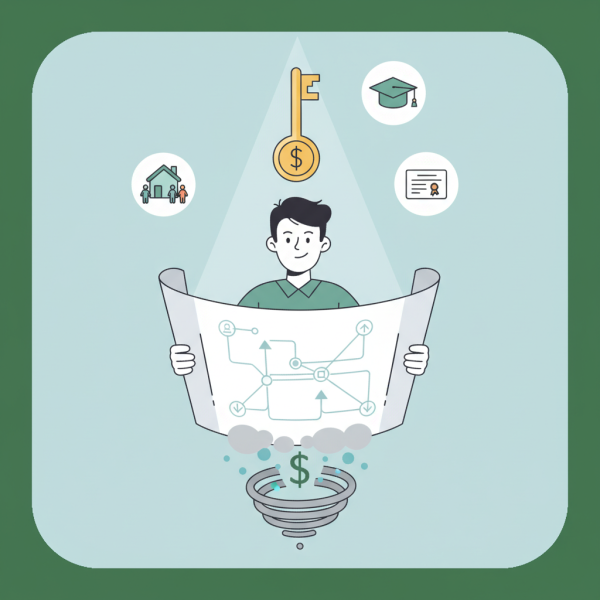
Student Loan Repayment Strategies for Financial Freedom
What you'll learn
 Income-Driven Repayment PlansStudent Loan ForgivenessRefinancing Student LoansEffective Debt Management
Mastering Your Student Loans: A Smart Approach to Repayment
Student loans can feel like a significant financial burden, a cloud hanging over your aspirations for financial freedom. However, with the right strategies and a proactive mindset, you can navigate the complexities of repayment, significantly reduce your debt, and pave the way for a more secure financial future. This article will demystify the various options available, from government-backed income-driven plans to potentially life-changing forgiveness programs and savvy refinancing opportunities, empowering you to take control of your student debt.
Understanding Your Student Loan Landscape
Before diving into repayment strategies, it's crucial to understand the types of loans you hold. Federal student loans often come with more flexible repayment options, including income-driven plans and access to forgiveness programs. Private student loans, on the other hand, typically have fewer borrower protections but might offer competitive interest rates for those with excellent credit. Knowing whether your loans are federal or private is the first step toward choosing the most effective repayment path.
Gather all your loan statements, login to your loan servicer's portal, and consolidate information about your loan balances, interest rates, and repayment terms. This foundational knowledge will be invaluable as you explore the strategies discussed below.
Navigating Income-Driven Repayment (IDR) Plans
Federal student loans offer several Income-Driven Repayment (IDR) plans designed to make your monthly payments more affordable by basing them on your income and family size. These plans are particularly beneficial if you're struggling to make payments or if your income fluctuates. While IDR plans can extend the repayment period, they also offer the potential for loan forgiveness after a certain number of years (typically 20 or 25 years) if you still have a remaining balance.
Key IDR plans include:
- Pay As You Earn (PAYE): Generally sets payments at 10% of your discretionary income, but never more than the 10-year Standard Repayment Plan amount. Forgiveness after 20 years.
- Revised Pay As You Earn (REPAYE): Payments are typically 10% of your discretionary income, with no cap. Forgiveness after 20 years for undergraduate loans and 25 years for graduate loans.
- Income-Based Repayment (IBR): Payments are generally 10% or 15% of your discretionary income, capped at the 10-year Standard Repayment Plan amount. Forgiveness after 20 or 25 years.
- Income-Contingent Repayment (ICR): Payments are either 20% of your discretionary income or what you'd pay on a fixed 12-year plan, whichever is less. Forgiveness after 25 years.
It's important to recertify your income and family size annually to ensure your payments remain accurate. Failing to do so can result in your payments increasing or capitalized interest.
Exploring Student Loan Forgiveness Programs
Beyond IDR plan forgiveness, specific programs exist that can eliminate a portion or even all of your federal student loan debt. These programs are often tied to public service or specific career paths.
- Public Service Loan Forgiveness (PSLF): This program forgives the remaining balance on your Direct Loans after you've made 120 qualifying monthly payments while working full-time for a qualifying employer (government, 501(c)(3) non-profit, or certain other non-profits). The payments must be made under an IDR plan.
- Teacher Loan Forgiveness: Eligible teachers who work for five consecutive academic years in low-income schools can have up to $17,500 of their Direct Subsidized and Unsubsidized Loans (and certain FFEL Program loans) forgiven.
- Total and Permanent Disability (TPD) Discharge: If you're deemed totally and permanently disabled, you may be eligible to have your federal student loans discharged.
- Borrower Defense to Repayment: If your school misled you or engaged in other misconduct in violation of certain state laws, you might be eligible for discharge of your federal student loans.
Always research the eligibility requirements carefully and keep meticulous records when pursuing any forgiveness program, as the rules can be strict and require diligent adherence.
Strategic Refinancing for Lower Rates
Refinancing involves taking out a new loan to pay off your existing student loans. This can be a powerful strategy for saving money, especially if interest rates have dropped or if your credit score has significantly improved since you first took out your loans. Refinancing can also simplify your repayment by consolidating multiple loans into a single monthly payment.
Consider these points when thinking about refinancing:
- Federal vs. Private Loans: Refinancing federal loans into a new private loan means losing access to federal benefits like IDR plans, deferment/forbearance options, and forgiveness programs. This trade-off should be carefully weighed.
- Credit Score Impact: Lenders will check your credit score and income to determine your eligibility and interest rate. A strong credit score is key to securing the best rates.
- Interest Rate Types: You can often choose between a fixed interest rate (stays the same) or a variable interest rate (can change over time). Fixed rates offer predictability, while variable rates may start lower but carry more risk.
Always shop around and compare offers from multiple lenders to find the most competitive rates and terms. Use online tools to get pre-qualified without impacting your credit score.
Other Smart Repayment Tactics
Beyond the major strategies, several other smart moves can accelerate your debt repayment:
- Pay More Than the Minimum: Even an extra $20-$50 per month can significantly reduce the total interest paid and shorten your repayment timeline. Direct these extra payments towards loans with the highest interest rates first.
- Bi-Weekly Payments: By paying half your monthly payment every two weeks, you'll make one extra full payment each year, similar to getting a 13th month of payments.
- Automate Payments: Many servicers offer a small interest rate reduction (e.g., 0.25%) for enrolling in automatic payments. This also ensures you never miss a payment.
- Budgeting and Lifestyle Adjustments: Create a detailed budget to identify areas where you can cut expenses and redirect those savings towards your loans. Small sacrifices can lead to big savings over time.
Taking a holistic approach to your personal finances will always yield the best results when tackling student loan debt.
Summary: Taking Charge of Your Student Loan Debt
Navigating student loan repayment requires a clear understanding of your options and a proactive approach. By familiarizing yourself with income-driven repayment plans, exploring potential forgiveness programs, and strategically considering refinancing, you can significantly lighten your financial load. Combining these major strategies with smart, everyday repayment tactics will empower you to tackle your student debt efficiently and confidently, ultimately bringing you closer to your financial goals and peace of mind.
Comprehension questions
 What are the primary differences between federal and private student loans regarding repayment options?Describe two types of Income-Driven Repayment (IDR) plans and how they determine monthly payment amounts.What are the main eligibility requirements for the Public Service Loan Forgiveness (PSLF) program?When might refinancing a student loan be a beneficial strategy, and what is a key consideration when refinancing federal loans?