
Navigating Multi-State Financial Implications for Remote Workers
What you'll learn
 Multi-state Tax RulesDomicile vs. ResidencyTax Reciprocity AgreementsPreventing Double Taxation
The landscape of work has undergone a dramatic transformation, with remote work becoming a cornerstone for many industries. While offering unparalleled flexibility and the freedom to choose your living environment, this new paradigm introduces a complex web of financial implications, especially concerning state taxes when you live in one state but work for an employer based in another. Understanding these nuances is crucial for any financially savvy individual aiming to optimize their money and avoid unexpected tax burdens. This article will guide you through the intricacies of multi-state taxation, providing clarity and actionable insights to navigate your remote work journey with confidence.
The Remote Work Revolution and Tax Realities
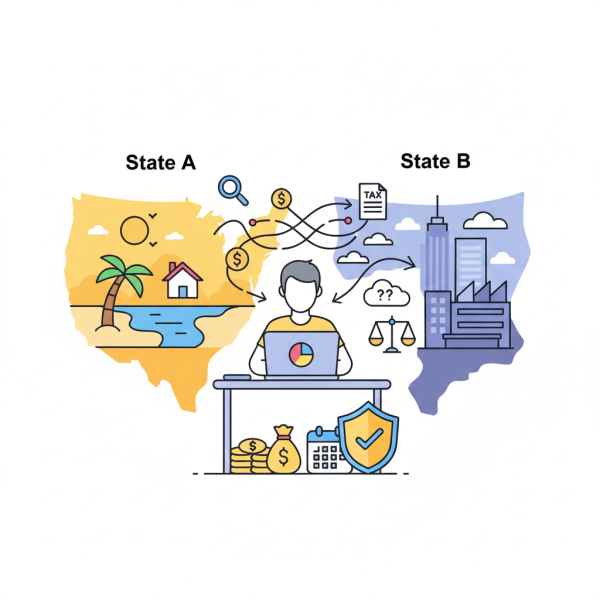
The shift to remote work, accelerated by recent global events, has blurred geographical lines for employment. While your daily commute might now be from your bedroom to your home office, the tax authorities of various states still view your earnings and location through specific lenses. Simply working from your living room in State A for a company headquartered in State B does not automatically simplify your tax situation; in fact, it often complicates it significantly. Each state has its own set of rules regarding income sourcing, residency, and employer obligations, creating a mosaic of potential tax liabilities that remote workers must understand.
Ignoring these complexities can lead to significant financial headaches, including double taxation, penalties, and interest charges. Proactive planning and a thorough understanding of the regulations in both your resident state and your employer's state are paramount for responsible financial management in the remote era.
Understanding Domicile vs. Residency
One of the most fundamental concepts to grasp in multi-state taxation is the distinction between "domicile" and "residency." These terms are often used interchangeably in everyday language but carry precise legal meanings that profoundly impact your tax obligations.
Domicile: This refers to your true, fixed, and permanent home – the place where you intend to return whenever you are absent. You can only have one domicile at any given time. Establishing domicile typically involves factors like where you vote, register your car, get your driver's license, maintain bank accounts, own property, and spend the majority of your non-work time. It's about intent and where your life is truly centered.
Residency: This is generally about physical presence. You can be a resident of multiple states at once, even if you only have one domicile. Most states define residency based on the number of days you spend within their borders (e.g., more than 183 days in a calendar year). If you spend enough time in a state, even if it's not your permanent home, you may be considered a statutory resident and subject to income tax there.
For remote workers, your domicile state will typically tax all your income, regardless of where it's earned. Your resident state (if different from your domicile) might also tax your income, particularly if you spend a substantial amount of time there.
The "Convenience of the Employer" Rule
Certain states employ what's known as the "convenience of the employer" rule, which can significantly impact remote workers. Under this rule, if an employee works remotely from another state for a company based in one of these "convenience" states, their income may still be subject to taxation by the employer's state, even if the employee never physically steps foot there. The rationale is that the employee is working remotely for their own convenience, not because the employer requires it.
States notorious for this rule include New York, Delaware, and Pennsylvania. For instance, if your employer is in New York and you choose to work from Florida (which has no state income tax), New York might still claim a right to tax your wages, arguing that your presence in Florida is for your convenience, not a business necessity for the New York employer. This can lead to complex tax filings and potential double taxation if not managed correctly. It's vital to research if your employer's state has such a rule.
State Income Tax Reciprocity Agreements
To alleviate some of the complexities and prevent double taxation, many states have entered into reciprocity agreements with neighboring states. These agreements simplify tax filings for residents who work across state lines by allowing them to pay income tax only to their state of residency, not to the state where they physically work or where their employer is based. This means income earned in the work state is exempt from that state's taxes if the employee is a resident of a reciprocity state.
For example, if you live in Wisconsin and work for a company in Minnesota, and both states have a reciprocity agreement, you would only pay income tax to Wisconsin. Your employer would withhold Wisconsin taxes from your paycheck, rather than Minnesota taxes. This significantly streamlines tax preparation.
However, these agreements are not universal. It's crucial to verify if such an agreement exists between your resident state and your employer's state. If not, you'll likely need to file non-resident tax returns in the employer's state and claim a credit for taxes paid to another state on your resident state return.
Credit for Taxes Paid to Other States
When reciprocity agreements are not in place, the primary mechanism to prevent double taxation is the "credit for taxes paid to other states." Most states offer this credit to their residents. Essentially, if you are required to pay income tax to a non-resident state (where you work or where your income is sourced) and also to your resident state on the same income, your resident state will typically allow you to claim a credit for the taxes you paid to the other state.
This credit ensures you don't pay tax on the same dollar twice. The amount of the credit is usually limited to the lower of the tax paid to the non-resident state or the tax that would have been owed to your resident state on that same income. While it prevents double taxation, it often requires filing tax returns in multiple states, which adds to administrative effort.
Payroll Withholding and Estimated Taxes
Proper payroll withholding is a critical component of managing your remote work taxes. If your employer is aware of your remote work arrangement and your out-of-state residency, they should adjust your withholding accordingly. This might involve withholding taxes for your resident state, for their state (if the convenience rule applies), or a combination.
It is imperative to communicate your residency status clearly to your employer's HR or payroll department. Review your pay stubs regularly to ensure the correct state taxes are being withheld. If insufficient taxes are being withheld, or if you have income from other sources (like freelancing), you may need to make quarterly estimated tax payments to avoid underpayment penalties. This applies to both federal and state taxes. Utilizing tax calculators and consulting with a tax professional can help you determine appropriate estimated payment amounts.
Potential Pitfalls and How to Avoid Them
Remote work taxation is ripe with potential missteps. Being aware of common pitfalls can save you money and stress.
- Ignoring "Physical Presence" Rules: Even brief work-related travel to your employer's state can trigger tax obligations there, particularly if you don't typically work in that state.
- Misunderstanding Domicile: Simply renting out your old home and moving to a new state isn't enough to change domicile in the eyes of tax authorities. Intent and actions must align.
- Assuming Reciprocity: Do not assume your states have an agreement. Always verify the current status of reciprocity agreements.
- Neglecting Employer Nexus: If your presence in a state creates a "nexus" for your employer, they might have additional business tax obligations. While primarily an employer issue, it can sometimes affect employment terms.
- Under-withholding: Failing to adjust your W-4 or make estimated payments can lead to substantial penalties at tax time.
Money-Saving Tips for Remote Workers
Beyond compliance, there are strategies to potentially save money as a remote worker navigating multi-state tax landscapes:
- Consult a Tax Professional: Especially for complex situations, a tax advisor specializing in multi-state taxation can offer personalized advice and ensure compliance while identifying potential savings. This is an investment that often pays for itself.
- Maintain Meticulous Records: Keep detailed records of your physical location on workdays, travel receipts, and any correspondence related to your residency or work location. This documentation is invaluable if you ever face an audit.
- Understand State Tax Rates: If you have flexibility, consider the overall tax burden (income, sales, property taxes) of potential states of residence. Moving to a state with no or lower income tax can yield significant savings, but always weigh all financial factors.
- Optimize Home Office Deductions: If you are an independent contractor or run your own business, you may be eligible for home office deductions. Employees generally cannot take these deductions, but check state-specific rules.
- Leverage Retirement Accounts: Maximize contributions to tax-advantaged retirement accounts like 401(k)s and IRAs to reduce your taxable income, regardless of your state residency.
Summary
Navigating the financial implications of remote work across state lines demands a proactive and informed approach. Understanding the distinctions between domicile and residency, being aware of specific rules like the "convenience of the employer" clause, and utilizing mechanisms such as reciprocity agreements and tax credits are fundamental to avoiding double taxation and ensuring compliance. Clear communication with your employer regarding your residency, regular review of withholding, and meticulous record-keeping are essential practices. By taking these steps and potentially consulting with a tax professional, remote workers can confidently manage their tax obligations, prevent costly errors, and position themselves for greater financial stability and savings in this evolving work environment.
Comprehension questions
 What is the primary difference between domicile and residency in the context of state taxation for remote workers?Explain the purpose of state income tax reciprocity agreements and how they benefit remote employees.What strategies can remote workers employ to prevent double taxation when living in one state and working for an employer based in another?