
Health Savings Accounts as a Powerful Retirement Investment Tool
What you'll learn
 HSA Basics and EligibilityTriple-Tax Advantage ExplainedStrategic HSA Investment for RetirementMaximizing Long-Term HSA Benefits
For those striving to build a robust financial future, understanding every tool at your disposal is crucial. While many view a Health Savings Account (HSA) simply as a way to manage current medical expenses, savvy individuals recognize its incredible potential as a powerful, triple-tax-advantaged retirement investment vehicle. It's more than just a savings account; it's a strategic asset that, when used correctly, can significantly bolster your long-term financial security and even outshine traditional retirement accounts in some aspects. Let's delve into how you can transform your medical savings into a cornerstone of your retirement planning.
What Exactly is a Health Savings Account (HSA)?
Before we explore its investment potential, it's important to grasp the fundamentals of an HSA. An HSA is a tax-advantaged savings account that can be used for qualified medical expenses. To be eligible for an HSA, you must be enrolled in a High-Deductible Health Plan (HDHP) and not be enrolled in Medicare. You cannot be claimed as a dependent on someone else's tax return. These accounts are owned by you, not your employer, meaning they are portable and remain yours even if you change jobs or retire.
Contributions to an HSA can come from you, your employer, or both, up to an annual limit set by the IRS. For 2024, the individual contribution limit is $4,150, and the family limit is $8,300. Those aged 55 and over can contribute an additional catch-up contribution of $1,000.
The Triple-Tax Advantage Unpacked
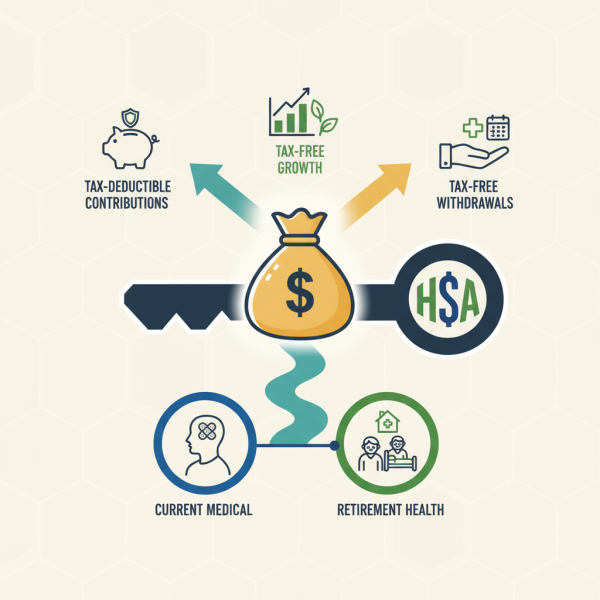
The true allure of an HSA, especially when considering it as a retirement tool, lies in its unique triple-tax advantage. This set of benefits makes it exceptionally powerful:
- Tax-Deductible Contributions: The money you contribute to an HSA is typically tax-deductible, reducing your taxable income in the year you make the contributions. If your employer contributes, those contributions are usually pre-tax, offering similar tax savings.
- Tax-Free Growth: Once your HSA balance reaches a certain threshold (often around $1,000-$2,000, depending on the custodian), you can invest the funds in a variety of options like mutual funds, exchange-traded funds (ETFs), and stocks. Any investment gains, dividends, or interest earned within the HSA grow tax-free.
- Tax-Free Withdrawals: This is where the magic truly happens. If you use HSA funds for qualified medical expenses at any age, the withdrawals are completely tax-free. This includes current medical costs, as well as those incurred decades later in retirement.
No other financial account offers this potent combination of tax benefits. Traditional IRAs and 401(k)s offer tax-deductible contributions and tax-deferred growth, but withdrawals in retirement are taxed. Roth accounts offer tax-free withdrawals but contributions are after-tax. The HSA stands alone with its triple advantage.
HSA as an Investment Vehicle: Thinking Beyond Current Costs
Many individuals make the mistake of using their HSA solely as a spending account for immediate medical needs. While this is a valid use, it overlooks the incredible long-term potential. By intentionally paying for current medical expenses out-of-pocket and allowing your HSA funds to grow untouched, you create a powerful investment engine.
Imagine contributing to your HSA for decades, allowing the tax-free growth to compound. By the time you reach retirement, you could have a substantial sum. This accumulated wealth can then be used to cover significant healthcare costs in your later years, which are often substantial. Think about Medicare premiums, deductibles, co-pays, and even long-term care expenses – all of which can be paid with tax-free HSA withdrawals.
How to Maximize Your HSA for Retirement
To truly leverage your HSA as a retirement tool, a strategic approach is essential:
- Contribute the Maximum: If feasible, aim to contribute the maximum allowed by the IRS each year. The more you put in, the more you can grow.
- Invest Your Funds: Don't let your HSA sit in a low-interest cash account. Once you have an emergency fund for immediate medical needs (often a few thousand dollars), invest the rest in diversified, growth-oriented funds. Research your HSA custodian's investment options and choose wisely.
- Pay for Medical Expenses Out-of-Pocket: This is the key strategy. If you can afford it, pay for your current medical expenses using funds outside of your HSA. Keep detailed records and receipts of these expenses. This allows your HSA balance to continue growing tax-free.
- Reimburse Yourself Later: In retirement, or whenever you need the funds, you can reimburse yourself for all the qualified medical expenses you paid out-of-pocket over the years. Since there's no time limit on when you can take these tax-free withdrawals, you essentially create a tax-free personal bank for future needs.
- Consider it a Last Resort for Non-Medical Expenses: After age 65, HSA funds can be withdrawn for any purpose without penalty, though they will be subject to ordinary income tax, similar to a traditional IRA. This makes it a flexible backup retirement account if you run out of other funds, though using it for qualified medical expenses is always the most tax-efficient route.
Comprehension questions
 What are the three main tax advantages associated with a Health Savings Account (HSA)?How does the strategy of paying for current medical expenses out-of-pocket maximize an HSA's potential as a retirement investment?What are the key eligibility requirements for opening and contributing to an HSA?After what age can HSA funds be withdrawn for non-medical expenses without penalty, and what tax implications apply then?